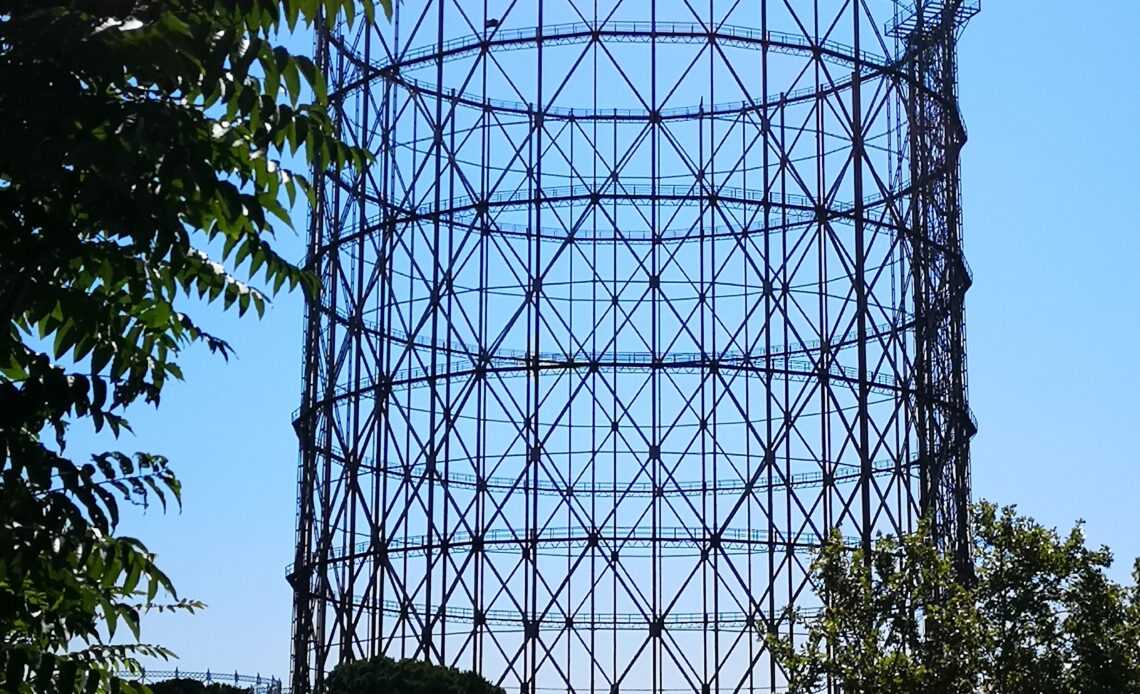
Since 1937, the skyline of the Ostiense area, in Rome, is defined by an “ancient giant”, built to store and supply gas to the town: the so-called “Gazometro”.
Some other structures like this had been already built around 1910, but they were not so tall, and wider. Why here?
It’s easy: because here there is the river and a bridge, called by the Romans “the iron bridge” (although its real name is “ponte dell’Industria”).
Pio IX had it built, in 1863, together with the path of the railway. This area, in that moment, was perfect: it was a huge area where several industries could be placed. Within few years, here many buildings have been made: Mulini Biondi (to process the wheat), Mira Lanza (cleaning stuff) and, obviously, the gas.
Before the big “Gazometro”, there were some smaller gasometers in via Flaminia and via dei Cerchi. I don’t dare imagining how the presence of a metal structure next to the Circus Maximus and not far from the Domus Aurea, the imposing villa of Nero, looked out of tune!
The large gasometer, which measures almost 100 meters in height (so much so that it was for a long time the largest in Europe) at the moment is used only for special events. The most recent dates back to last March, when it was illuminated in white, red and green as a symbol of hope in the fight against the coronavirus.
Yet, there are those who still hope that it can return to play a more active role in the city, if not as a gas plant, at least as an artistic structure and as a historical memory.